
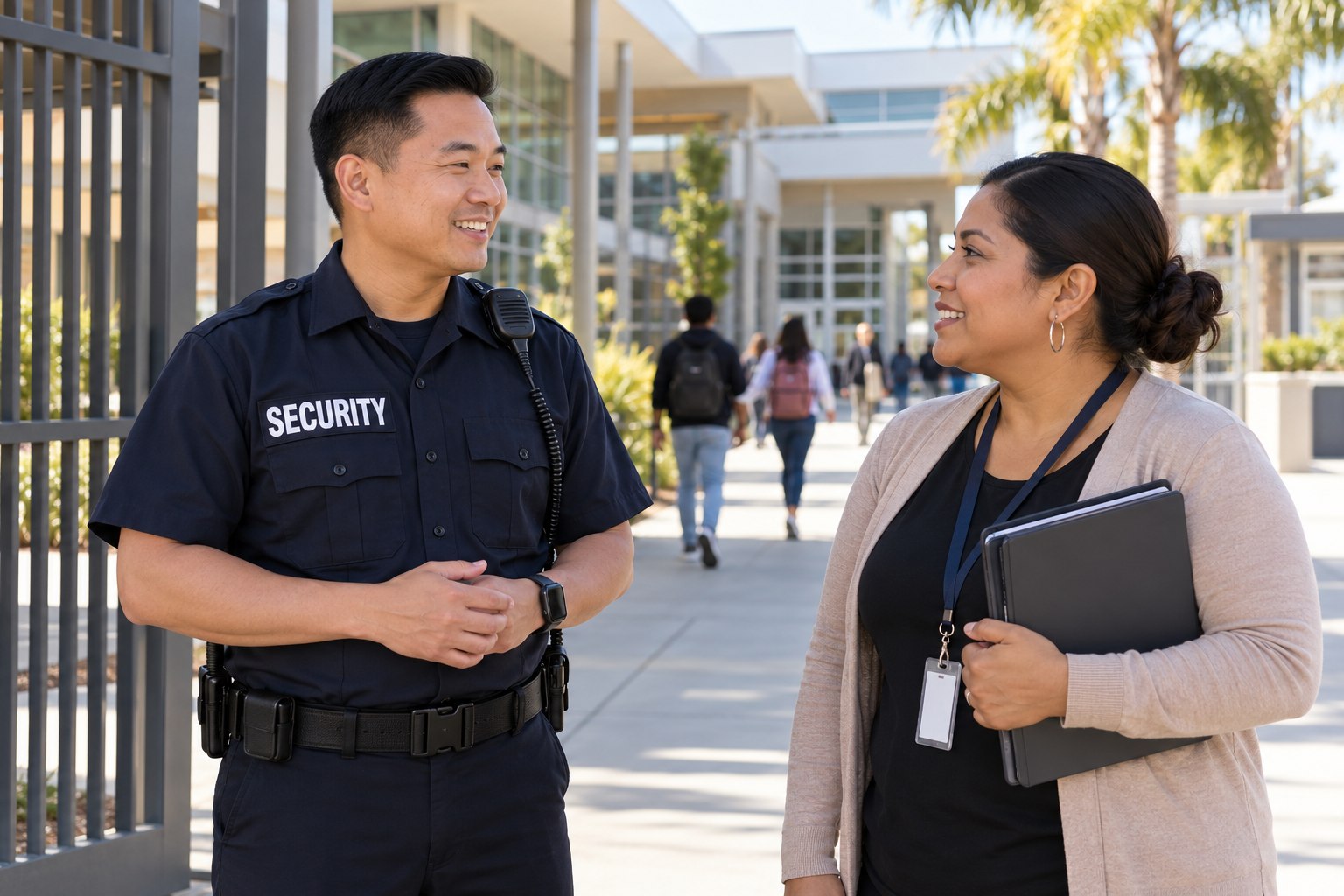
A School Resource Officer Is a Law Enforcement Role
The United States Department of Justice COPS Office describes a school resource officer as a career law enforcement officer assigned in a community policing capacity to an educational agency. The sworn law enforcement role distinguishes an SRO from personnel who work in school security without that status.
This distinction should not become a claim that every person wearing a campus uniform is a police officer. Nor does a familiar title establish every detail of a person's authority in a particular situation. Families benefit from knowing the actual role rather than assuming that school safety personnel all have the same legal powers.
School Security Has Its Own Responsibilities
BSIS describes school security functions as protecting persons or property, preventing theft or unlawful taking of school district property, and reporting unlawful activity to the district and local law enforcement. Its guidance also identifies specific school security training requirements for covered personnel working at school district and community college district properties.
That framework reflects a distinct professional assignment. It does not make a guard a school administrator or counselor. A guard's presence should also not be described as an automatic transfer of police authority. The person's employer, role, qualifications, and applicable rules remain relevant to understanding what they are assigned to do.
Administration and Security Decisions Are Not Identical
A principal may address educational operations, a teacher may supervise learning, and a security professional may work within a campus assignment. These roles can interact without becoming interchangeable. A parent's concern about a classroom decision is different from a concern about unauthorized activity near a building.
A hypothetical example shows the distinction. A family disputes a student's academic placement. Another family reports a threatening visitor outside the school office. The school may need to address both concerns, but the same professional does not necessarily decide both. Knowing the nature of the issue helps avoid treating every campus disagreement as a police matter or every threatening incident as ordinary school administration.
A Campus Assignment Is Not General Student Discipline
Students and parents may encounter security personnel during a difficult incident and assume the person also controls school discipline. That assumption can blur the difference between supporting campus safety and deciding an educational consequence. A guard's involvement does not itself explain which school official makes an administrative decision.
Similarly, the presence of a sworn officer does not mean every disagreement requires criminal enforcement. The role needs to be understood in the context of the situation and applicable policy. An accurate article can explain those distinctions without publishing tactics, promising enforcement outcomes, or assigning powers that have not been verified for the particular person.
Clarity Supports Realistic Expectations
Schools can review the role of their safety personnel in plain language. Families should be able to understand whether they are speaking with a guard, sworn officer, or administrator. Clear titles do not answer every legal question, but they reduce confusion about the source of a decision.
Paradigm can be contacted about a campus's circumstances and whether an available private security service fits its needs. That conversation should reflect the school's requirements and the provider's actual scope. Private security should not be presented as a replacement for all law enforcement, educational leadership, or student support. Distinct roles can contribute to the same campus while retaining different professional boundaries.